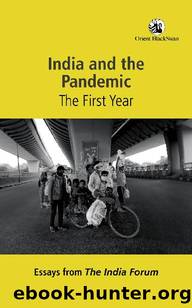
India and the Pandemic: The First Year, Essays from The India Forum by The India Forum
Author:The India Forum [Forum, The India]
Language: eng
Format: epub
Published: 0101-01-01T00:00:00+00:00
[â*] Published in The India Forum, 10 April 2020.
This chapter was first published with the same title as the CEPR Policy Insight No. 102, April 2020. It is reprinted here with permission of the Centre for Economic Policy Research.
13
Hunger Grows as Indiaâs Lockdown Kills Jobs
Results of a Survey from 12 States*
Rahul Lahoti, Amit Basole, Rosa Abraham, Surbhi Kesar and Paaritosh Nath
The Covid-19 global pandemic and its associated containment measures have taken a heavy toll on economies and societies worldwide. In India, the national lockdown, imposed on 24 March 2020 and subsequently extended four times to 31 May, has had a profound effect on employment and earnings.
Livelihoods have been devastated at unprecedented levels. Food insecurity and economic vulnerability have increased to staggering proportions. Hunger deaths and suicides linked to economic stress are being reported from various parts of the country.1
Any recovery from this crisis will be slow and very painful. The immediate relief measures do not appear to be in proportion to the severity of the situation on the ground.
In a survey of nearly 5,000 self-employed, casual and regular wage workers across 12 states of India, conducted in collaboration with civil society organisations between 13 April and 23 May, we have found a massive increase in unemployment and an equally dramatic fall in earnings.2 Two-thirds of our respondents have lost work. The few informal workers who were still employed during the lockdown saw their earnings drop by more than half. Almost 8 in 10 are eating less food than before. The impact of job losses and food insecurity has been higher for certain groups of people: Muslims, Dalits, women and those with lower levels of education.
As late as May, even the grossly inadequate government relief measures, in the form of cash transfers or increased rations, had not reached large sections of the economically vulnerable population. Half of our respondents reported not receiving any cash transfers.
Three structural characteristics of the Indian economy and decades of underinvestment in public goods have combined with the sudden and severe lockdown to generate widespread misery. First, for Indiaâs predominantly informal labour force, which earns income day-to-day, any stoppage of economic activity instantly destroys employment and earnings. Second, the lopsided nature of economic growth has created a large divide between rich and poor states. Third, the same uneven growth process has created employment opportunities in larger cities much faster than in smaller towns and villages.
This unequal development manifests as migration flows of millions of workers, creating dense populations of the urban poor. When these long-run factors are put together with Indiaâs persistent underinvestment in health and housing, our vulnerabilities to the present crisis become painfully clear.
The vulnerable population in urban areas has been severely impacted, but relief measures have not reached them. The Union government should follow the lead of states such as Odisha and Himachal Pradesh, which are trying out an urban employment generation programme, and Kerala, which already has such a programme running. State finances may not allow effective urban employment guarantees, but the central government can certainly do this.
Download
This site does not store any files on its server. We only index and link to content provided by other sites. Please contact the content providers to delete copyright contents if any and email us, we'll remove relevant links or contents immediately.
| Anthropology | Archaeology |
| Philosophy | Politics & Government |
| Social Sciences | Sociology |
| Women's Studies |
Cecilia; Or, Memoirs of an Heiress — Volume 1 by Fanny Burney(32558)
The Great Music City by Andrea Baker(32019)
Cecilia; Or, Memoirs of an Heiress — Volume 2 by Fanny Burney(31956)
Cecilia; Or, Memoirs of an Heiress — Volume 3 by Fanny Burney(31942)
We're Going to Need More Wine by Gabrielle Union(19046)
All the Missing Girls by Megan Miranda(16027)
Pimp by Iceberg Slim(14507)
For the Love of Europe by Rick Steves(14121)
Bombshells: Glamour Girls of a Lifetime by Sullivan Steve(14075)
Talking to Strangers by Malcolm Gladwell(13370)
Norse Mythology by Gaiman Neil(13365)
Fifty Shades Freed by E L James(13240)
Mindhunter: Inside the FBI's Elite Serial Crime Unit by John E. Douglas & Mark Olshaker(9343)
Crazy Rich Asians by Kevin Kwan(9292)
The Lost Art of Listening by Michael P. Nichols(7506)
Enlightenment Now: The Case for Reason, Science, Humanism, and Progress by Steven Pinker(7313)
The Four Agreements by Don Miguel Ruiz(6765)
Bad Blood by John Carreyrou(6621)
Weapons of Math Destruction by Cathy O'Neil(6280)
